
Nancy Wolff: The Art of Floral Surface Pattern Design
Some artists paint flowers. Nancy Wolff builds entire worlds from them. Her surface pattern designs — covering fabrics, wallpapers, stationery, and home goods — transform botanical subjects into rhythmic, repeating compositions that feel both timeless and contemporary. Stylized blooms, layered leaves, and unexpected color combinations define a body of work spanning decades in the textile and surface design industry.
This collection features Nancy Wolff’s floral pattern designs — from soft pastel gardens on teal backgrounds to bold, vibrant bouquets on black. Each pattern demonstrates her mastery of seamless repeat design: the art of creating a motif that tiles infinitely without visible seams. For textile designers, illustrators, and pattern enthusiasts, her work is a living textbook of composition, color theory, and botanical stylization.
The Signature Style: Stylized, Not Literal
Nancy Wolff does not paint flowers the way a botanist would. Her flowers are stylized — simplified, graphic, and personality-driven. A peony becomes a series of concentric ruffled circles. A daisy transforms into clean radiating petals with a bold yellow center. Leaves take on geometric forms with visible vein patterns drawn as fine line work. The result is flora that feels handcrafted and intentional, not photographic.
This approach is the hallmark of professional surface pattern design. Unlike fine art botanical illustration, which aims for scientific accuracy, surface patterns must repeat seamlessly across yards of fabric or rolls of wallpaper. Every element must be designed to tile — which means shapes must be simplified, colors must be flattened, and compositions must balance density with breathing room.
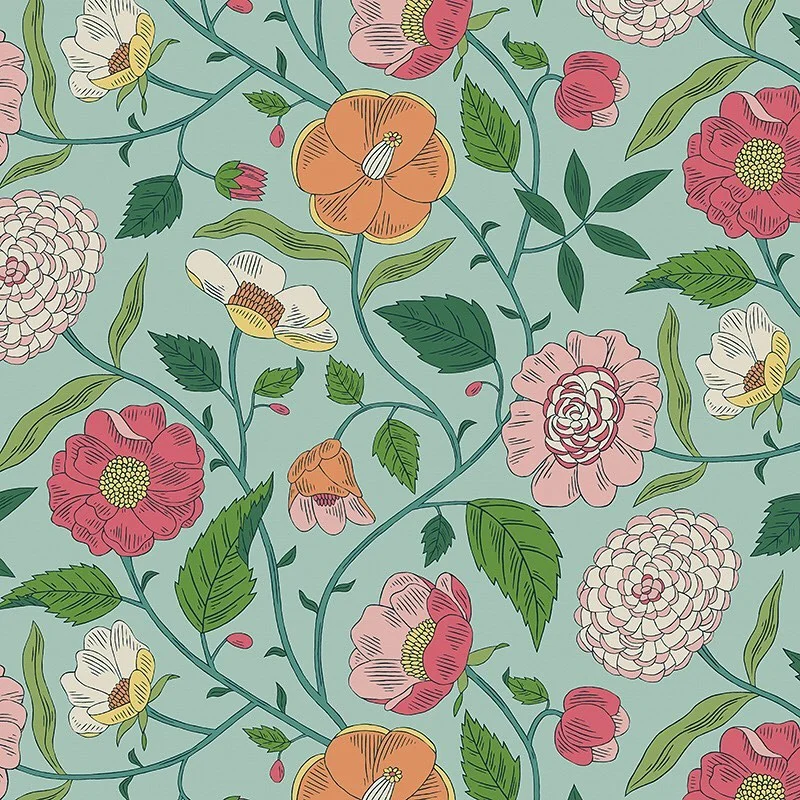
The pattern above shows Wolff at her most characteristic. On a soft dusty teal background, peonies, poppies, and daisy-like blooms interweave with varied green leaves on curving stems. Notice how each flower type has its own visual personality — the ruffled pink peony, the flat-petaled orange poppy, the crisp white daisy — yet they share a consistent line quality and color saturation level. This consistency is what makes the repeat invisible: the eye accepts the pattern as continuous because every element speaks the same visual language.
Color Mastery: From Pastel Gardens to Midnight Bloom
One of the most striking aspects of Nancy Wolff’s portfolio is her command of color. She works across the full spectrum — soft pastels, vibrant jewel tones, earthy naturals, and dramatic darks — but each palette is always carefully controlled. Let’s explore the range.
The Dark Canvas: Black and Navy Backgrounds
Wolff’s boldest patterns place vibrant flowers against black or navy backgrounds, creating maximum contrast and drama. This approach transforms traditional floral design into something graphic and contemporary.
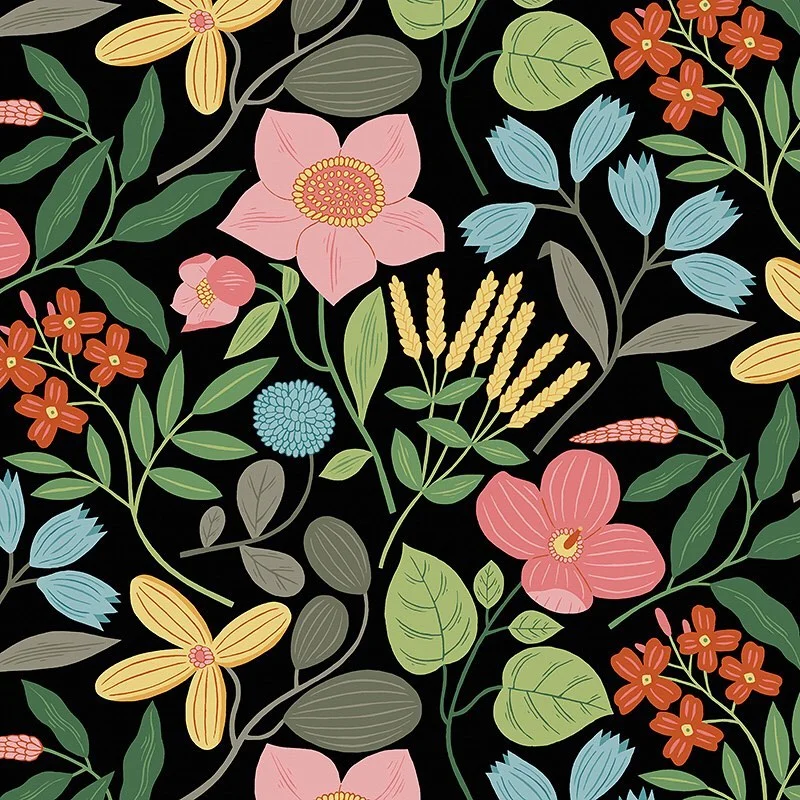
On a black background, pink, yellow, orange, and blue flowers glow like stained glass. The dark canvas eliminates visual noise, allowing each flower to read as a pure color shape. Notice the variety: rounded pink peonies, striped yellow blooms, tubular blue flowers, and even wheat stalks — all coexisting in one composition. This eclectic mixing of flower types is a Wolff signature. Where traditional floral patterns often use one or two flower species, Wolff creates botanical collages that feel like a garden in full, chaotic bloom.
Navy and Blue: Cool Elegance
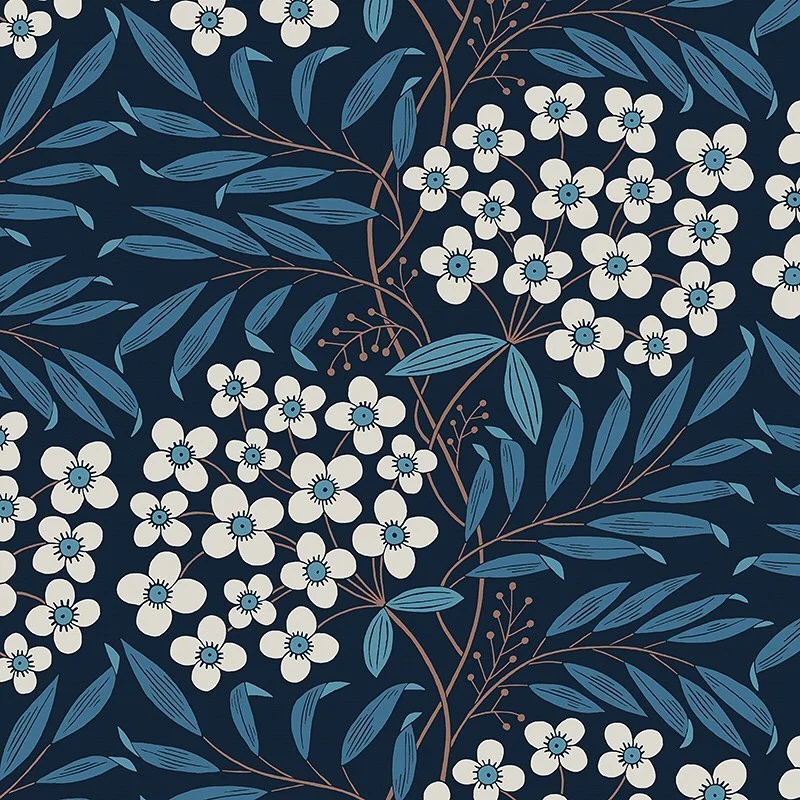
The navy-and-white pattern demonstrates the power of a limited palette. White flowers and tonal blue leaves against deep navy create a cool, moonlit atmosphere. Without warm colors to distract, the focus shifts entirely to shape and line quality. This is the classic “toile” approach — monochromatic storytelling through silhouette.
Blue and Gold: Timeless Luxury
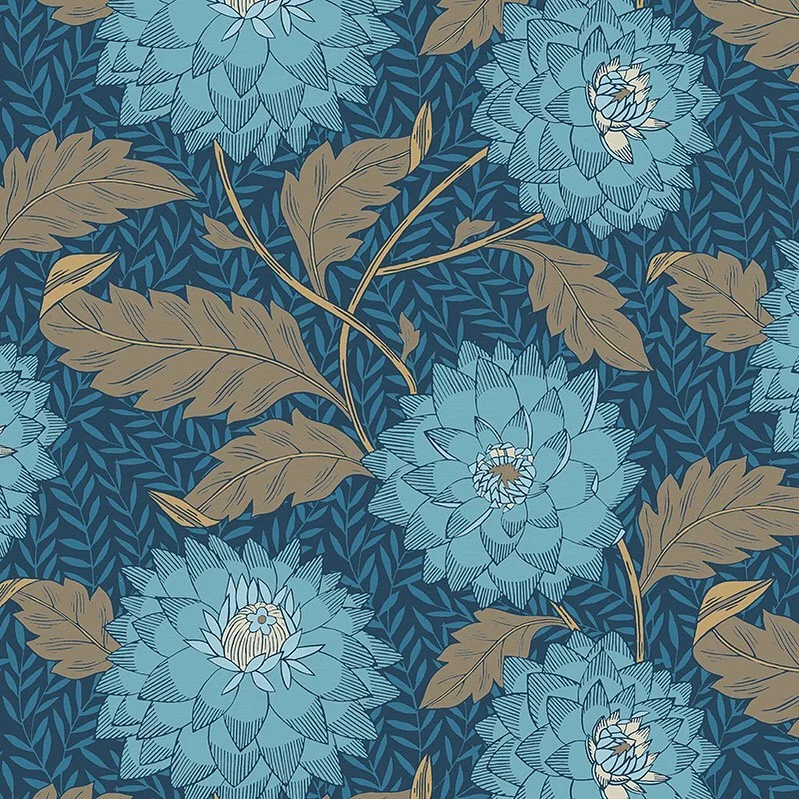
This pattern pairs muted teal-blue dahlia-like flowers with warm brown foliage on a deep blue background. The subtle fern pattern within the background adds depth without competing with the main motifs. The fine cross-hatching and line work give each petal and leaf a hand-drawn, crafted quality. This is surface design at its most sophisticated — layered, detailed, and endlessly rewarding to look at closely.
The Repeat: How Seamless Patterns Work
For those unfamiliar with surface pattern design, the technical challenge is the seamless repeat. A pattern must tile infinitely — horizontally and vertically — without visible breaks. This means the elements at the top edge must connect perfectly to the bottom edge, and the left edge must connect to the right.
Nancy Wolff makes this look effortless. Her repeats are organic and flowing — stems curve across boundaries, leaves bridge gaps, and flowers are distributed with rhythmic balance. The viewer never sees where one tile ends and the next begins. This level of craft requires not only artistic skill but mathematical precision in layout and spacing.
Bright and Playful: Pink and Orange Palettes
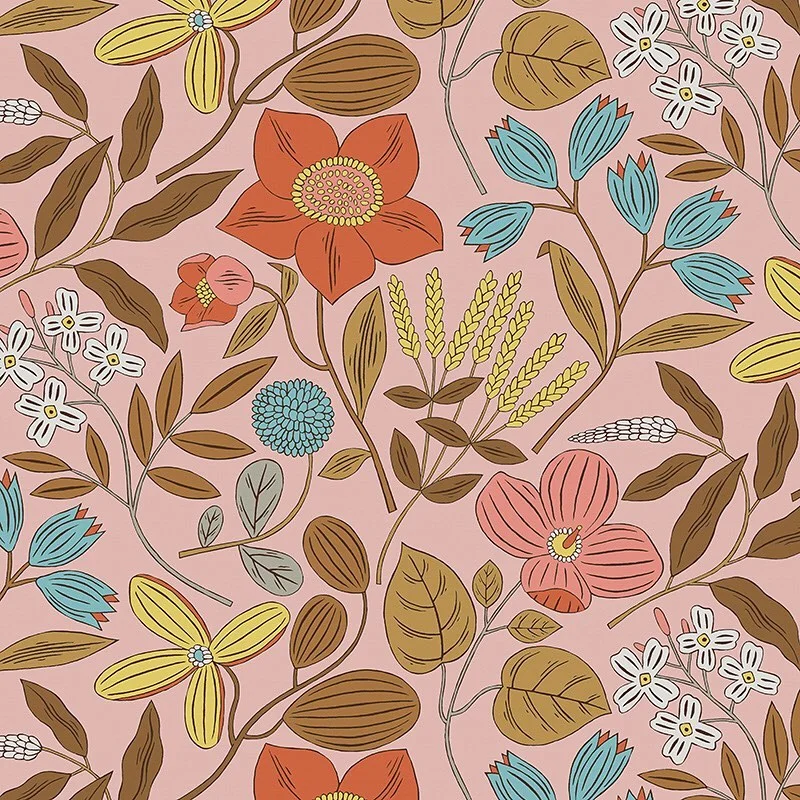
The pink-background pattern shifts the mood from dramatic to cheerful. Warm-toned flowers in coral, yellow, and white float on a soft pink canvas. The density is lower than the black-background patterns — more breathing room between elements creates a lighter, more airy feel. This demonstrates Wolff’s understanding that density controls mood: tight, dense patterns feel luxurious and traditional; sparse, open patterns feel modern and fresh.
Geometric Botanicals: When Flowers Meet Structure
Not all of Wolff’s patterns are purely organic. Some introduce geometric structure — vertical stripes, grids, and symmetrical layouts — that organize the botanical elements into architectural frameworks.
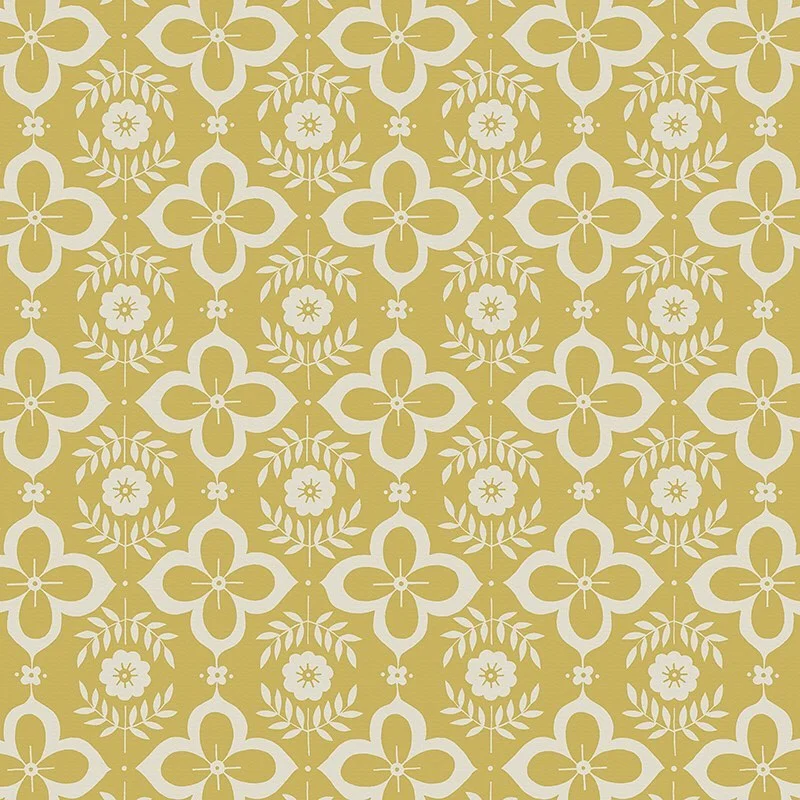
The yellow-background pattern uses white floral and geometric motifs in a structured, almost tiled arrangement. The bright, sunny background and clean white elements create a fresh, summery aesthetic — reminiscent of Mediterranean ceramics or folk art decoration. The geometric structure adds rhythm and order to the botanical subjects, creating a tension between organic shapes and architectural layout.
Single-Species Studies: Roses and Tulips
While Wolff is known for eclectic multi-flower compositions, she also creates patterns focused on a single flower species. These studies reveal her ability to find variety within repetition.
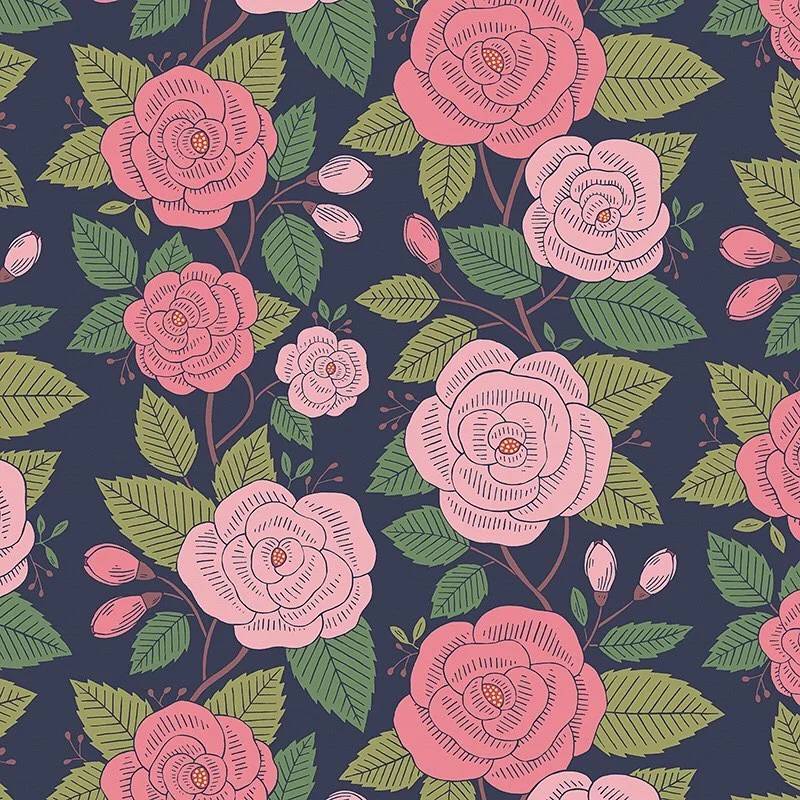
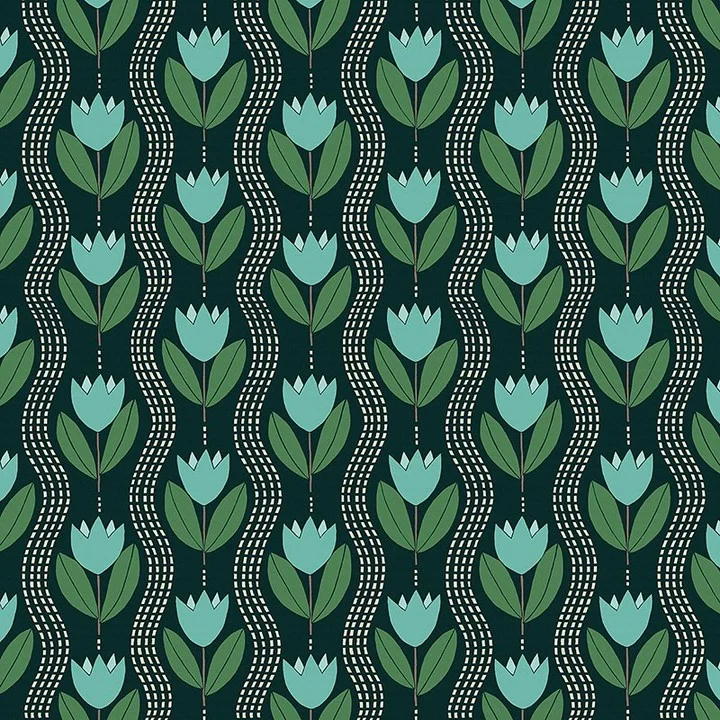
The rose pattern uses stylized pink roses — each flower a layered spiral of curved petals — against a dark background with green leaves. The tulip pattern places teal tulip silhouettes on a dark ground with delicate white dot detailing. In both cases, the single-species focus allows deeper exploration of the flower’s form. Notice how the same flower is varied through scale, angle, and opening stage, creating rhythm within uniformity.
Color on Color: The Orange Background Study
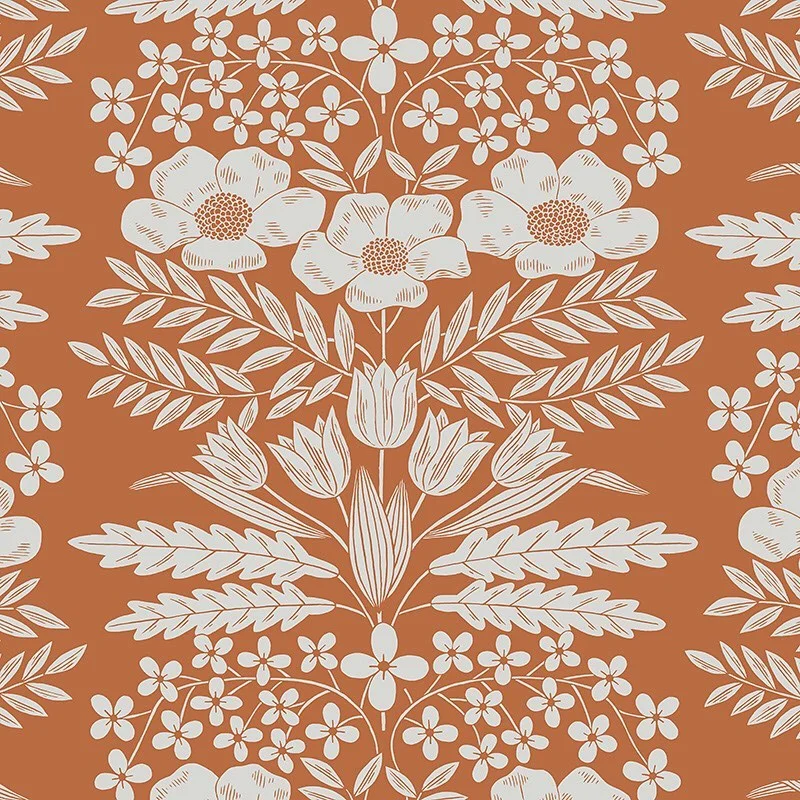
White flowers and leaves on a solid orange background create one of the most graphic patterns in the collection. The high contrast between white motifs and saturated orange ground makes this pattern visible from across a room — ideal for wallpaper or statement upholstery. The simplicity of the two-color approach (white on orange) proves that Wolff’s designs work at any complexity level, from multicolor botanical collages to bold graphic statements.
What Designers Can Learn from Nancy Wolff
- Stylize, don’t copy. Wolff’s flowers are recognizable but never literal. Each species is reduced to its essential visual character — the ruffle of a peony, the spoke of a daisy, the cup of a tulip. Designers should find the “visual DNA” of their subject and amplify it.
- Mix species fearlessly. Traditional patterns often stick to one flower. Wolff combines peonies, poppies, daisies, wheat, and buds in a single composition. The variety creates energy and prevents monotony in repeat.
- Background color transforms everything. The same drawing approach looks completely different on teal, black, navy, pink, yellow, or orange. Changing the background is the fastest way to create a new collection from existing artwork.
- Density is a design decision. Tight patterns feel traditional and luxurious. Sparse patterns feel modern and fresh. Wolff uses both — the choice depends on the intended application (wallpaper vs. stationery vs. fabric).
- Line quality is identity. The hand-drawn, slightly textured line work — cross-hatching, fine veins, subtle irregularities — gives Wolff’s patterns a crafted, human quality that mass-produced digital patterns lack. In an era of vector perfection, imperfection is a differentiator.
- The repeat must be invisible. Every element in a surface pattern must work at the tile boundaries. This is engineering as much as art — and it is the skill that separates professional pattern designers from illustrators who draw flowers.
Explore More Nancy Wolff Patterns
Browse Nancy Wolff’s pattern designs for design reference:
- Nancy Wolff — the full collection of floral surface pattern designs
- Floral Pattern — broader floral pattern design reference gallery