Boy Patterned Shirt Adult Legs Doorway
Topics
Details
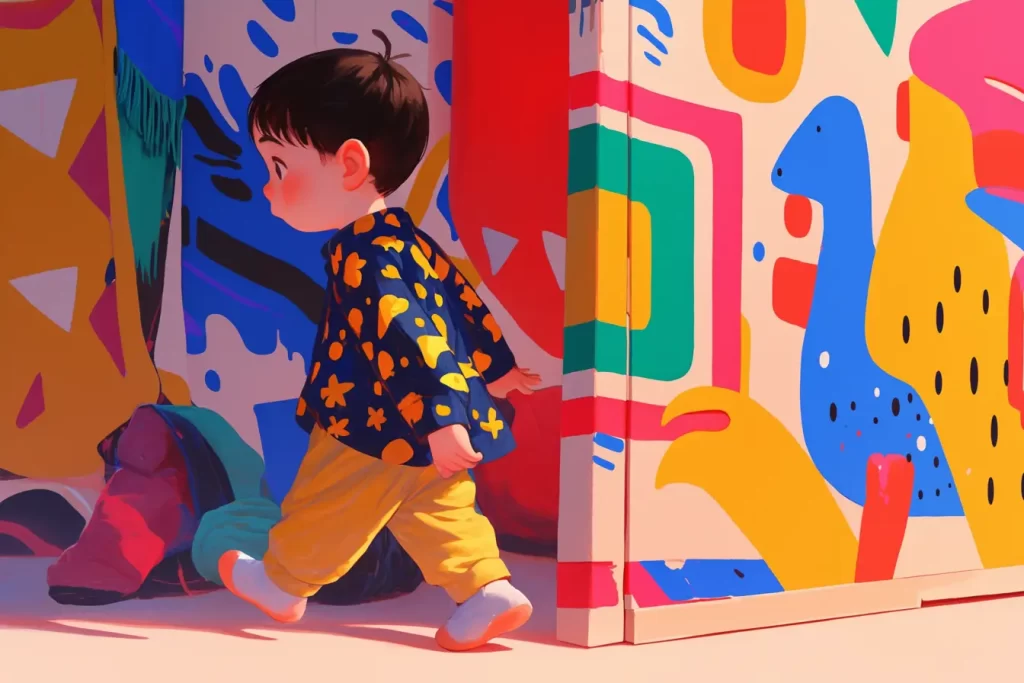
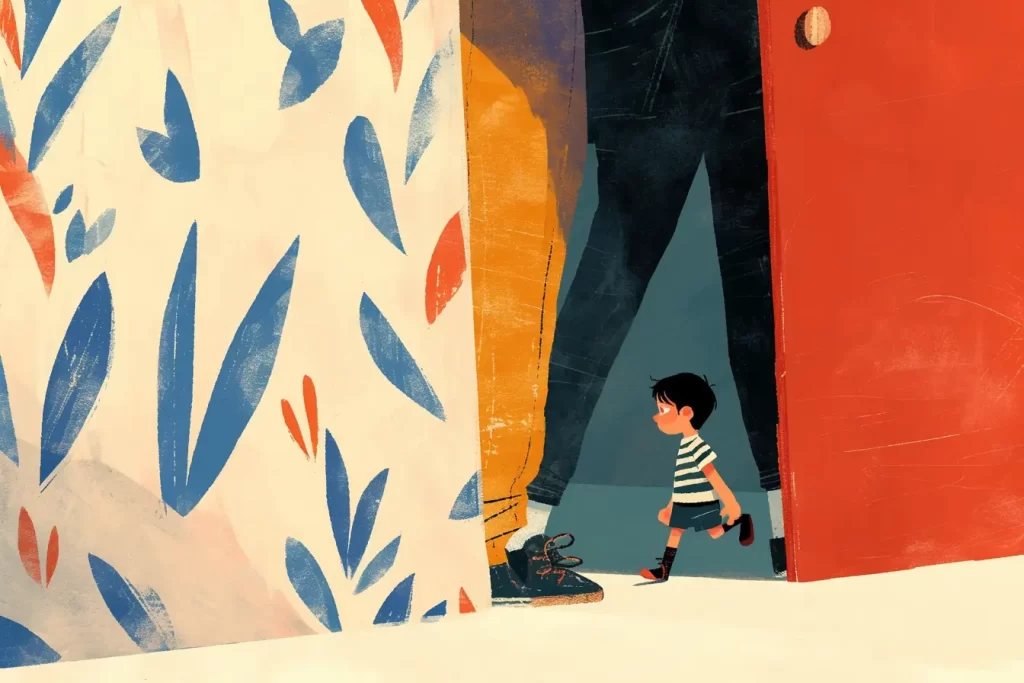
A small child in a green-and-white striped shirt and navy shorts walks toward the left, his gaze fixed on the massive legs of two adults who dominate the frame. One figure wears mustard-yellow trousers with a black sneaker, while the other is clad in dark denim jeans, both partially obscured by a bold red door on the right. To the left, a cream-colored surface features an abstract pattern of elongated blue leaves and scattered orange accents, rendered with visible brushstroke textures that suggest gouache or acrylic media.
The composition deliberately exploits scale disparity to evoke vulnerability or discovery, positioning the diminutive figure against towering adult limbs that function as architectural elements rather than fully realized characters. Color blocking drives the visual hierarchy: the saturated red door creates a hard edge that contrasts sharply with the organic, leafy motif on the adjacent wall, while the limited palette of primary blues, warm yellows, and deep blacks maintains cohesion across disparate surfaces. Textural variation between the flat color fields of the clothing and the expressive, painterly quality of the background pattern adds tactile depth to the otherwise flattened perspective.
Children's book illustrators might study the proportional relationships between the child and adult figures to understand how scale conveys emotional subtext without facial expression. Character designers could reference the specific stripe weight and garment silhouettes for period-accurate youth costuming, while environmental artists might extract the botanical pattern as a repeatable texture for interior set dressing. Storyboard artists working on coming-of-age narratives would find the spatial arrangement useful for planning shots that emphasize a protagonist's smallness within adult-dominated spaces.