
Green Leaves Nature Plant
Topics
Details
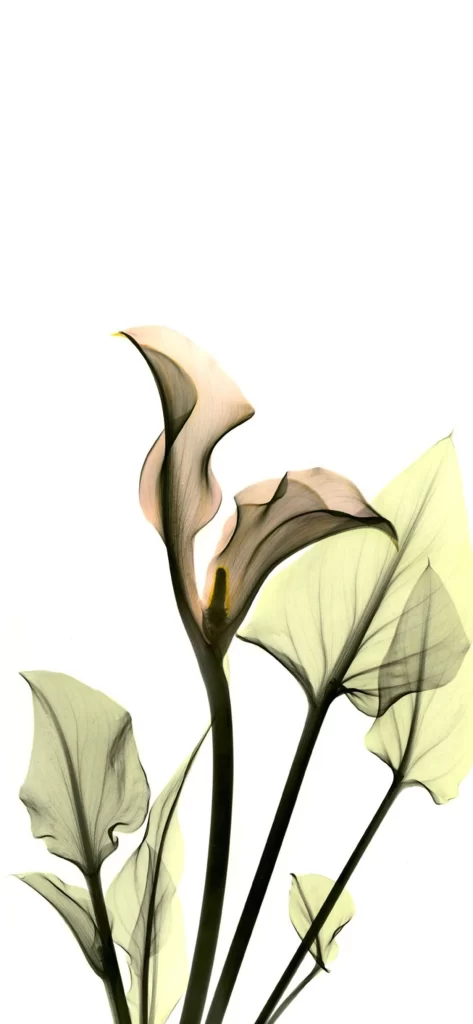
Backlit by a diffuse white source, the translucent foliage reveals an intricate network of pale green veins branching from a central stem. The composition focuses on the upper leaf's heart-shaped silhouette, where the chlorophyll-rich tissue transitions into near-transparency at the margins, creating a delicate gradient of mint and ivory. A secondary leaf appears softly blurred in the lower register, establishing a shallow depth of field that emphasizes the organic geometry of the primary specimen.
Visual interest derives primarily from the material translucency, which transforms botanical anatomy into a study of linear rhythm and tonal subtlety. The venation patterns function as natural vector lines, offering a complex yet harmonious structure that balances scientific precision with ethereal softness. Such interplay between solid form and light penetration provides a rare opportunity to examine plant morphology without the distraction of surface texture or color saturation.
Botanical illustrators might employ this reference to practice rendering transparent organic membranes or to study the mathematical distribution of vascular tissue in monocotyledonous plants. Textile designers could translate the vein architecture into lace patterns or embroidery motifs that require both delicacy and structural logic. Additionally, lighting specialists may analyze how diffused backlighting interacts with semi-transparent biological materials to achieve specific atmospheric effects in still-life photography.