Unique Perfume Design Bottle
Topics
Details
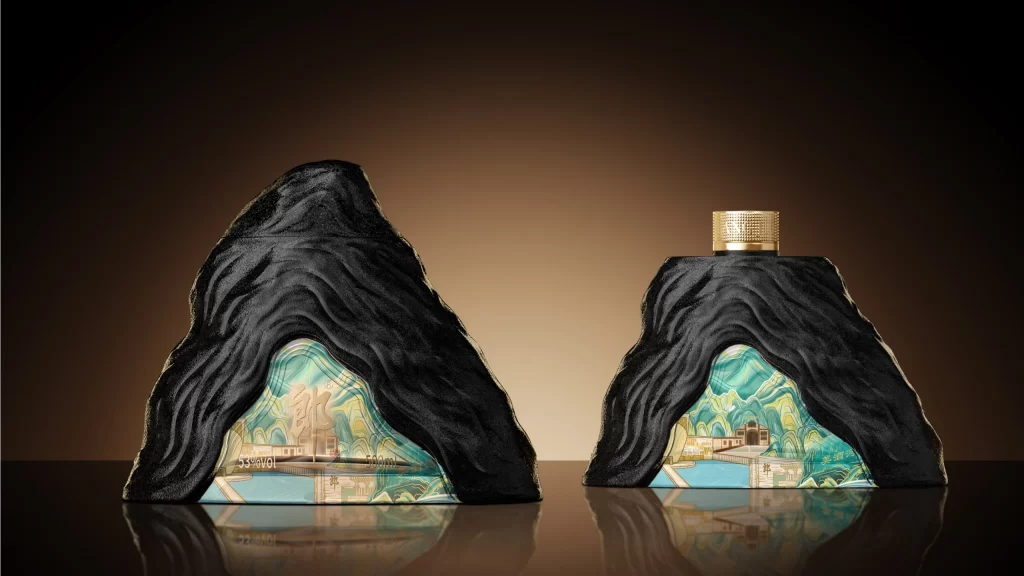
Against a warm, gradient backdrop that shifts from deep umber to a luminous amber glow, two sculptural perfume vessels command the frame with their dramatic, mountain-like silhouettes. Each bottle is encased in a matte black shell featuring deeply textured, undulating ridges that mimic the geological striations of a craggy rock formation. Through a triangular aperture in the center of each piece, a vibrant, translucent interior reveals a miniature landscape rendered in turquoise, emerald, and pale gold, complete with architectural structures and calligraphic text including '55%VOL' and '500ml'. The composition places one bottle slightly forward and to the left, while its counterpart sits further back on the right, distinguished by a cylindrical gold cap with a perforated grid pattern. Soft, directional lighting creates subtle highlights along the dark exterior's crevices and casts crisp reflections across the polished surface below.
What distinguishes this particular design is its bold juxtaposition of organic, almost brutalist exterior textures against the delicate, jewel-toned artistry hidden within. The vessel functions as a three-dimensional diorama, transforming the act of viewing a fragrance container into an experience akin to peering through a natural cave opening at a serene, painted vista. By integrating traditional landscape painting techniques—evident in the misty mountains and classical architecture—with modern, avant-garde packaging forms, the object achieves a rare balance between raw materiality and refined cultural storytelling.
Product designers specializing in luxury cosmetics or high-end spirits packaging would find this reference invaluable when conceptualizing containers that require narrative depth beyond mere containment. Art directors working on campaigns for heritage brands might study the interplay between the opaque outer structure and the illuminated inner scene to develop visual metaphors for discovery and exclusivity. Additionally, 3D modelers tasked with creating assets for cinematic advertising could utilize this as a benchmark for achieving realistic subsurface scattering effects in translucent materials combined with complex surface topographies.